How to Cite


Abstract
It is with a sense of quiet satisfaction and shared responsibility that we present the first issue of JRMC Case Reports, a special supplement of the Journal of Rawalpindi Medical College devoted exclusively to clinical case reporting. At Rawalpindi Medical University, our affiliated hospitals Holy Family Hospital, Benazir Bhutto Hospital, and Rawalpindi Teaching Hospital serve a very large and diverse patient population. Every day, clinicians working in these settings encounter patients who challenge routine thinking and remind us that medicine is learned most deeply at the bedside. Some encounters offer small but practical insights, while others fundamentally change how we understand a disease process. This journal has been created to capture those lessons, document them with care, and share them with colleagues who face similar realities in their clinical practice.
Clinical case reports hold a modest but powerful place in medical literature. They translate everyday clinical complexity into structured, meaningful narratives that can be easily understood and remembered.1,2 For medical students and early career doctors, writing a case report encourages close observation, ethical sensitivity, disciplined engagement with literature, and clarity in clinical communication.3 For practicing clinicians, particularly those working in resource constrained environments, a well written case report often provides timely guidance when standard protocols do not fully apply, such as in patients with unusual presentations, overlapping comorbidities, or limited diagnostic options.4 Through JRMC Case Reports, we aim to link bedside learning with scholarly writing and connect local clinical experience with the wider medical community.
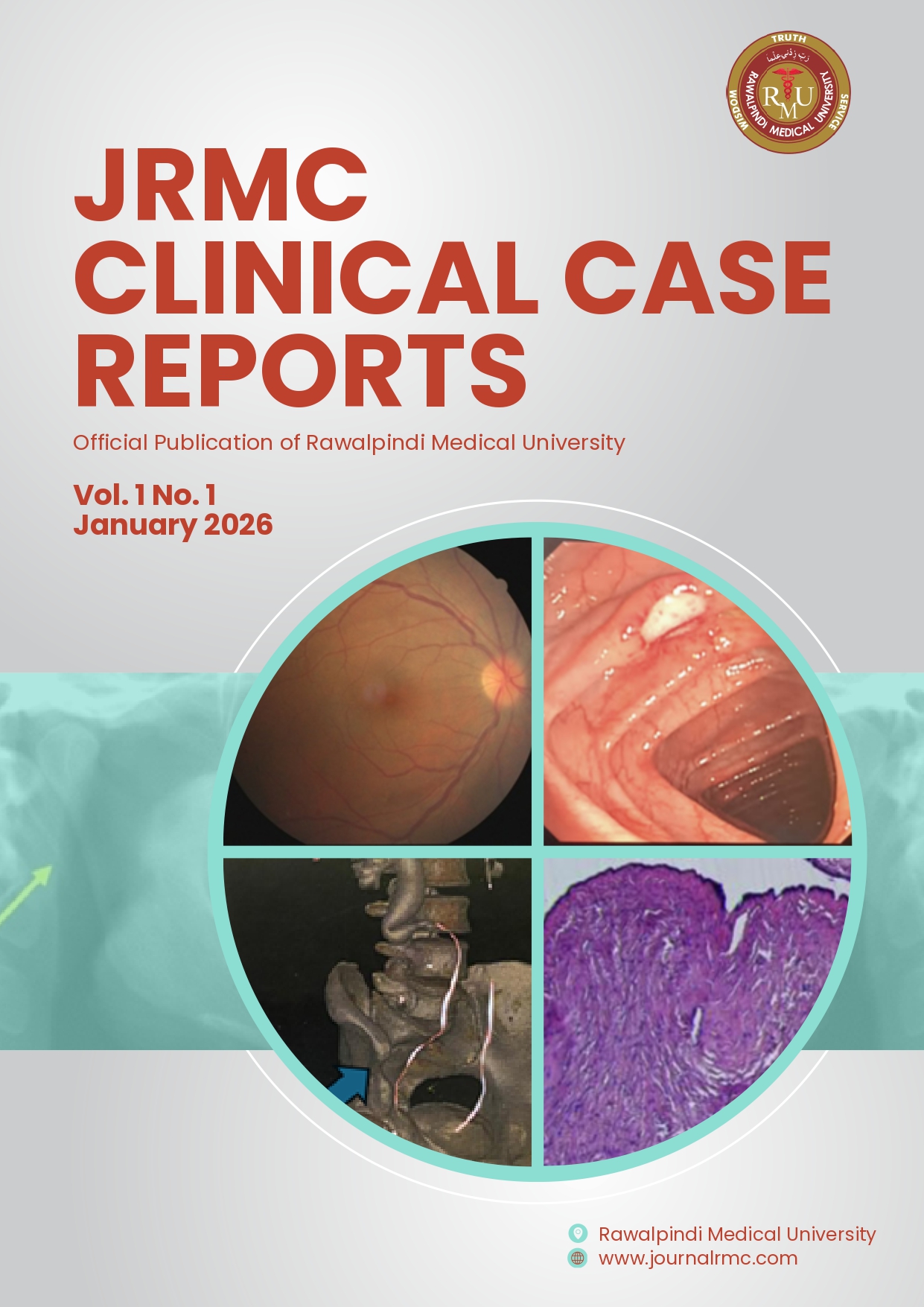
The cases presented in this inaugural issue reflect the breadth and relevance of focused clinical reporting. They include a young patient with primary AL amyloidosis presenting with macroglossia and spontaneous chest wall bruising, an early and severe ocular manifestation of Behçet’s disease identified through occlusive retinal vasculitis, a child with Budd–Chiari syndrome secondary to Burkitt’s lymphoma, a life threatening postpartum choriocarcinoma initially mistaken for retained products of conception, and an infant who developed iatrogenic Cushing syndrome following inappropriate use of topical steroids. Each report is concise, clinically grounded, and rooted in local practice realities. Collectively, they represent a growing body of practical knowledge that we believe will be of value to a wide range of readers.
Publishing case reports from RMU affiliated hospitals offers a particular strength. Our institutions receive patients from varied socioeconomic backgrounds, often presenting late and with complex clinical needs. This diversity naturally produces cases that are educational and clinically relevant. While rare and striking cases deserve attention, equal importance must be given to well documented presentations of known conditions, clear descriptions of clinical techniques, transparent reporting of complications, and honest reflections on decision making in difficult situations. Such reports strengthen everyday clinical judgment and support safe patient care.
Upholding ethical and scientific standards remains central to this initiative. JRMC Case Reports is firmly grounded in principles of responsible publishing, transparency, and integrity.5 All submissions are expected to meet established requirements including informed consent where applicable, appropriate ethical oversight, clear disclosure of conflicts of interest, and accurate attribution of authorship. The editorial team is committed to guiding authors through a supportive and constructive review process, particularly for trainees and early career clinicians. Attention to clinical images, timelines, and evidence based conclusions will remain a priority, with patient dignity always at the centre of our work.
For postgraduate trainees and young clinicians who may be unfamiliar with academic writing, this journal provides an accessible and meaningful starting point. Preparing a case report allows authors to reflect on their clinical reasoning and communicate it in a structured manner that benefits others. Through mentorship and editorial guidance, we hope to build confidence and competence in clinical scholarship across our institutions.
To our readers, we invite you to approach this journal as you would a trusted colleague. Read with curiosity, reflect critically, and contribute when possible. In Pakistan, the medical knowledge we most urgently need often grows from our own clinical experiences. By sharing these experiences with honesty, humility, and academic rigour, we strengthen not only our literature but also our collective practice. We hope JRMC Case Reports becomes a dependable companion for trainees preparing for assessments, clinicians navigating complex decisions, and small research teams documenting local challenges.
With sincere appreciation for the authors who entrusted us with their work, and for the reviewers and editorial colleagues who shaped this issue, we welcome you to JRMC Case Reports. We look forward to its growth as a platform that remains relevant, ethical, and consistently present in the service of patients and the medical community
References
References
Cox K. Stories as case knowledge: case knowledge as stories. Medical education. 2001 Sep 30;35(9):862-6.
Hurwitz B. Narrative and the practice of medicine. The Lancet. 2000 Dec 16;356(9247):2086-9.
Florek AG, Dellavalle RP. Case reports in medical education: a platform for training medical students, residents, and fellows in scientific writing and critical thinking. Journal of Medical Case Reports. 2016 Apr 6;10(1):86.
Firat AC, Araz C, Kayhan Z. Should we do away with them?. Journal of Clinical Anesthesia. 2017 Feb 1;37:74-6.
Lane T. Journal publication ethics and implications for life science researchers: a COPE perspective. Emerging Topics in Life Sciences. 2018 Dec 21;2(6):763-7.
Nishizawa T, Ishizuka K, Otsuka Y, Nakanishi T, Kawashima A, Miyagami T, Yamashita S. Writing case reports can improve seven components in clinical reasoning. International Medical Case Reports Journal. 2024 Dec 31:195-200.

This work is licensed under a Creative Commons Attribution-ShareAlike 4.0 International License.
Copyright (c) 2026 Muhammad Umar, Arsalan Manzoor Mughal